

The self-production scheme for grid-connected systems in medium and high voltage has been in place in Tunisia since 2009, under Law No. 2009-7 of February 9, 2009, concerning energy management.
This scheme was incorporated into the new regulatory framework of 2015 (Law No. 2015-12 of May 11, 2015, and Decree No. 2016-1123 of August 24, 2016), which grants self-producers the right to transport electricity produced to various consumption sites and to sell the surplus to STEG (Société Tunisienne de l’Électricité et du Gaz) within a limit of 30% of the annually produced electricity, through a tariff set by the decision of the Minister of Energy of June 1, 2014.
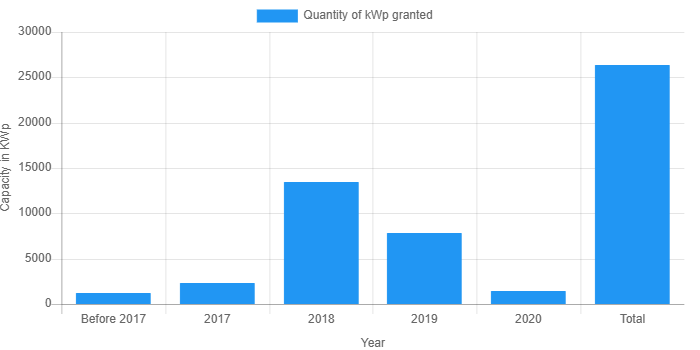
As of December 2022, the ministry had granted 300 agreements for the installation of photovoltaic systems with a cumulative power of 60MW.
Despite this, the achievements for grid-connected MV/HV projects still fall short of the target set by the 2017-2020 program, which is 210MW, including 130MW in PV and 80MW in wind power. For this reason, the government has proposed new reforms, under Law No. 2019-47 on improving the investment climate (Articles 7 and 8), allowing the possibility of creating a self-production company dedicated to the production and sale of electricity from RES (Renewable Energy Sources) to one or more self-consumers, each with a subscribed power above a threshold set by order of the minister in charge of energy. The implementing decree of this new provision was published on February 25, 2020 (Decree No. 2020-105 amending and supplementing Decree No. 2016-1123 of August 24, 2016).
This new scheme was created under the cross-cutting Law No. 2019-47 (Article 7), giving self-producers the possibility to create project companies and partner with developers to produce and sell them electricity from renewable energies. The implementing texts are being developed: a draft contract for the transport and sale of surpluses has been prepared and was subject to public consultation in October 2022. The medium-voltage grid transport tariff will also be defined after the transport contract is approved by ministerial order.
Self-generation is a major axis in Tunisian energy transition policy and contributes to the diversification of the energy mix. Self-generation is destined to play an important role in achieving the objectives of power generation from renewable energy sources.
Electricity self-generation is possible for any local authority and public or private establishment that is connected to the national electricity network at Medium or High Voltage (MT-HT). This is mainly relevant for organizations active in the industrial, agricultural or service sectors. Any such bodies may file a request with the Ministry of Energy, Mines and Energy Transition (Ministère de l’Énergie des Mines et de la Transition Énergétique) to install the equipment necessary for MT-HT self-generation. This will need to be approved by an agreement with the Ministry.
The self-generation programme allows for the use of two options:
- On-site projects, without transmission of electricity through the grid
- Projects on remote sites, with electricity transmission through the grid
Projects without Transmission through the Grid
This type of project allows participating bodies to install their power generation unit directly on the premises of their activities. Since the power generated is consumed on site, such installations form a closed circuit, and transmission through the national grid is not required. Nevertheless, excess generation can usually be fed into the grid.
Excess power generation fed into the grid from the renewable generator, is recorded and invoiced monthly by STEG (Société Tunisienne de l’Électricité et du Gaz). The contractual relations between the self-generator and STEG are defined in the contract, “For the transmission of electrical energy produced from renewable energy installations connected to the HT-MT network and purchase of the surplus by STEG.” This surplus purchase contract is valid for a period of 20 years, after which, it is automatically renewable for subsequent periods of 1 year, unless terminated by either one of the parties.
Projects with Transmission through the Grid
This type of project allows the self-generator to install her or his production unit on a remote site, far from that of his primary activity.
The transmission of electricity from the point of generation to the point of consumption must necessarily pass along the national grid. Any surpluses generated but not consumed by the project, are fed directly into the grid.
Such surpluses are invoiced monthly by STEG as the sum of the current fed into the network over each hourly segment, multiplied by the tariff for the corresponding segment.
The terms and conditions for pricing surpluses are similar to those for self-generation without transmission. However, in the case of a project with electricity transmission, the transmission of electricity from the place of generation to the place of consumption is also taken into account, and the generator is invoiced by STEG for the use of its network. Charges on this tariff however, will only apply to the amount of electricity consumed by the generator – not to any surplus.
- Who can launch a project?
Any company (public, private, or local) connected to the national high or medium voltage electricity grid can produce electricity from renewable energy sources for its own consumption. - Surplus sales conditions:
Companies can sell up to 30% of their annual surplus production exclusively to the Tunisian Electricity and Gas Company (STEG).
The financial mechanism proposed within this program includes a grant from the Energy Transition Fund (ETF), in accordance with Government Decree No. 2017-983 of July 26, 2017. This decree defines the rules of organization, operation, and intervention modalities of the ETF.
Les Primes
- Financing intangible investments
Feasibility studies: a grant not exceeding 70% of the cost with a ceiling of thirty thousand dinars (30,000D) per establishment. 70%
30KDTAssistance and support actions: a grant not exceeding 70% of the cost of the actions with a ceiling of seventy thousand dinars (70,000 D) for each establishment. 70%
70KDT - Financing of tangible investments
For all other material investments: a grant not exceeding 20% of the investment cost, with a ceiling of two hundred thousand dinars (200,000 DT). 20%
200KDT
- Financing intangible investments
La première étape consiste à engager un bureau d’études agréé pour réaliser une étude de faisabilité technico-économique de votre projet d’auto-consommation. Cette étude évalue la viabilité technique et financière du projet en fonction de vos besoins énergétiques et de la capacité de production envisagée. Elle constitue une base solide pour vérifier que le projet est réalisable et rentable. À ce stade, il est important de prendre en compte les spécifications techniques et les contraintes réglementaires de l’installation envisagée.
- Contracter un bureau d’étude agréé pour les études de faisabilité
- Approuver l’étude de préfaisabilité
Bureau d’étude
Offre technique et financière du bureau d’étude
Cahier des Chagres pour la réalisation des études de faisabilité technico-économique
Une fois l’étude de faisabilité achevée, une demande d’étude préliminaire est adressée à la Société Tunisienne de l’Électricité et du Gaz (STEG). La STEG examine ensuite le dossier pour s’assurer que le projet est compatible avec les normes et exigences du réseau électrique national. Si le projet est jugé conforme, la STEG délivre un accord de principe. Cet accord est indispensable pour avancer dans la mise en œuvre du projet et pour s’assurer que le raccordement futur pourra être réalisé sans impact négatif sur le réseau.
- Approuver la notice d’impact environnemental
- Approuver l’étude préliminaire de raccordement ou de renforcement du réseau
- Approuver l’étude de faisabilité et payer le bureau d’étude
Avec l’accord définitif de la STEG, il est possible de choisir une entreprise d’installation agréée pour réaliser les travaux. Cette entreprise effectuera l’installation du système de production d’électricité, en veillant à respecter les normes techniques et les spécifications du projet. Après l’installation, une demande de réception technique est adressée à la STEG pour inspecter et approuver le raccordement au réseau. Le raccordement marque l’étape finale de mise en service de l’installation.
- Contracter une entreprise installatrice
ANME Direction des Energies renouvelables
- Informations sur le porteur de projet : Demande au nom du Directeur Général de l’ANME, documents d’identification de la commune
- Informations sur le projet : Copie de l’arrêté relatif à l’accord du Ministère en charge de l’Energie publié au JORT
- Informations sur la pertinence du projet : Etude technico-économique, facture pro-forma des prix des différentes composantes du projet
- Signature du contrat programme avec l’ANME après l’accord de la commission techniques.
La demande doit être déposée avant la réalisation des investissements
Avis positif
Modèle de dossier de demande de subvention
 Décret n 2017-983
ANME Direction des Energies renouvelables
Adresse : 1, Avenue du Japon, Cité Administrative- 1073 Montplaisir- B.P.213
Adresse e-mail : boc@anme.nat.tn
Téléphone : 71 906 900
Fax : 71 904 624 / 71 908 241
Heures d’ouverture : 08h30 – 11h30 / 13h30 – 16h30