Agriculture and energy efficiency
In a context where energy prices are expected to rise, the continued dissemination of energy efficiency solutions in agriculture is a real necessity to limit the dependence of farms on these fluctuations.
Multiple energy-saving solutions exist for various agricultural productions.
Some solutions are already applied on farms, particularly in livestock buildings and greenhouses. New solutions, some of which need to be experimented and tested, have significant long-term dissemination potential.
To promote the achievement of these energy consumption reduction goals in agriculture, it is essential to act both on behavioral changes and on the equipment and instruments offered.
Indeed, agriculture has many solutions to improve the energy efficiency of farms. The Energy Transition Fund now offers a range of tools and instruments to support farms in a rational use of energy.
These are mainly financial supports for investment in equipment that enables energy savings. The agricultural sector also consumes and produces energy, which will have an impact in terms of the evolution of agricultural production systems and the agricultural energy mix.
Furthermore, the evolution of energy prices and the climatic hazards conditioning yields require the continued support of energy efficiency in the agricultural sector and to limit the dependence of farms on energies.
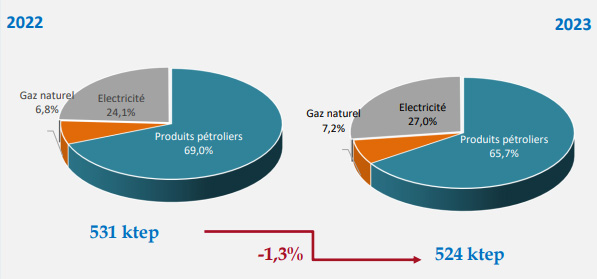
In 2023, the final energy consumption for the agriculture and fishing sector primarily came from oil products, with a proportion of around 66%, followed by electricity (27%) and then natural gas with only 7%.
Compared to 2022, final energy consumption in the agricultural sector registered a slight decrease of 1.3%. It should be noted that there is a strong trend of photovoltaic penetration for agricultural pumping under the self-production scheme, which has impacted electricity demand, which increased from 24.1% to 27%.